Revolutionizing 3D Rendering: Gaussian Splats Take the Spotlight
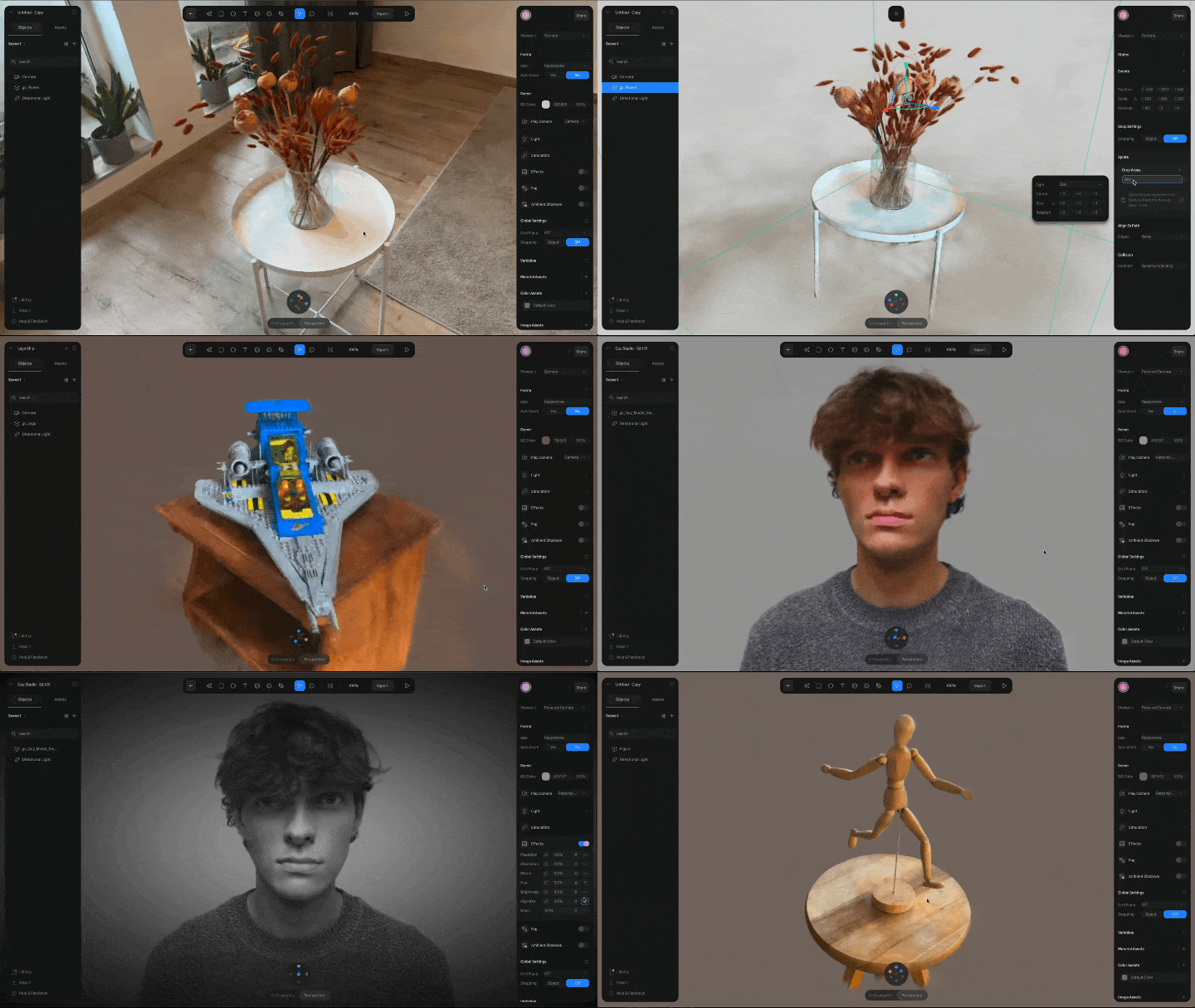
Revolutionizing 3D Rendering: Gaussian Splats Take the Spotlight
In a major leap forward for real-time 3D graphics, Gaussian splatting is emerging as a game-changing technique for rendering highly detailed scenes with unprecedented speed. Unlike traditional mesh-based methods, which rely on polygons to define surfaces, Gaussian splats use thousands of tiny 3D ellipsoids to reconstruct complex environments in real time.
First introduced in research papers and now making waves in game engines and AI-assisted 3D modeling, Gaussian splatting offers smooth, photorealistic results without the computational overhead of meshes. It enables instant rendering of point clouds, making it particularly useful for VR, AR, and digital twins.
Recently, tools like NVIDIA Instant NeRF and open-source projects have begun integrating Gaussian splats into workflows, allowing creators to turn raw point cloud data into immersive, high-fidelity experiences. The technique is already being explored for interactive gaming, AI-generated 3D worlds, and even geospatial visualization.
With major graphics firms investing in Gaussian splatting, it may soon become a mainstream alternative to traditional 3D modeling—paving the way for faster, more efficient, and visually stunning digital experiences.